Solving Problems
A Better Cheese
In February 2017, I journeyed to sunny Barcelona, Spain with my mom and sister. We planned one long day to hit all of the major attractions: a walking tour downtown to learn about the city and its history; the monumental Sagrada Familia; topped off with an evening stroll along the beach. The beach excursion turned out to be longer and farther away than we anticipated. By the time we finished, it was late, and we were hungry. When I checked my phone for nearby restaurants, a vegan tapas restaurant popped up, and my sister, whose interest was piqued, implored us to try it. The individual dishes were all geared toward reproducing well-known meat-based tapas and Spanish food but in vegan form, including a paella with vegan shrimp, grilled potatoes, and vegetable skewers. The tapas were delicious except for the vegan cheese. Instead of accentuating the dish, it intruded. With thoughtless bravado, I commented that I could develop a better vegan cheese. My sister quipped, “So why don’t you?”
I was stunned into silence; I had no good answer. Why didn’t I? At that point, I was working as a postdoctoral researcher in Zurich, Switzerland. My earlier decision to pursue a doctorate in biochemical engineering proved consequential. I had all the requisite education and training necessary to attempt a viable vegan cheese–development strategy. After returning to Zurich, I spelunked through the scientific literature and the ongoing work in the vegan cheese space.
My first question at this juncture was: Can cow cheese be made without the cow? After all, cheese, like all physical things, is constructed of molecules that in turn, and in combinations, make up individual ingredients. Perhaps it would be possible to source these ingredients outside of cow milk. Everyone knows that cheese is mostly fat and protein, and these building blocks are everywhere—in plants, fungi, and microbes. In particular, a cheese-specific protein found in cow’s milk—casein—imparts the unique, splendid properties of cheese: the stretchiness as cheese melts and the curdling of milk into a solid. If we could source casein from a microorganism such as bacteria, then we would no longer need the cow to make cheese.
Producing specialized proteins is a modern alchemy and a key thrust of biochemical engineering. The best-selling protein-based drug last year, Humira, a product of biochemical engineering, costs more than $100,000 for a single gram.1 In 2017, there were 3 million prescriptions for Humira, which is used in the treatment of autoimmune diseases such as rheumatoid arthritis and Crohn’s disease.2 In contrast, a gram of gold sells for a mere fifty bucks. The production of a protein drug like Humira involves importing specific DNA from animals that encodes the protein of interest into a host, or suspension, that contains producer cells. These host cells incorporate, transcribe, and translate the DNA sequence to create many copies of the final protein. In short, the producer cells, once implanted with the specialized DNA fragment, become factories that generate the chosen protein.
This process is called heterologous expression, and it arguably started with the mass production of insulin at Eli Lilly in the eighties.3 Up until that point, insulin used to treat human diabetes was distilled from the pancreas of a pig. In time, pioneering biochemical engineers learned that by using heterologous expression they could, instead, make bacteria produce insulin. To do this, they inserted the gene for insulin in the host bacteria. The gene, a contiguous sequence of DNA, contained all of the information necessary for the bacteria cell to produce insulin. The bacteria could then be grown in large bioreactors, the same vats in which we brew beer. For process efficiency reasons that I’ll discuss in Chapter 4, this method produces the same insulin as the animal-based procedure, only more cheaply and cleanly, and without pigs having to sacrifice their pancreases.
In my own process, I pondered whether or not casein could be produced the same way that we produce insulin, Humira, and numerous other proteins. It turned out that this was not a new idea. There were already a few—albeit small—casein endeavors involving similar concepts. I also learned that the problem wasn’t easy. Casein has post-translational modifications, meaning that, after the protein is synthesized by the cow, it’s further modified chemically to confer additional properties. For casein, these modifications are critical in the assembly of protein molecules into a scaffold of larger spheres, or casein micelles.4 Dairy fat preferentially resides within these micelle spheres, and dairy products could not exist without them. Butter is created by churning, where the micelles are physically broken apart, and the fat floats to the top. Cheese is created by applying acid or heat to denature the casein protein at the surface of the micelles. This denaturation induces the micelles to glob together and form the cheese curd.
The capacity to perform post-translational modifications depends on machinery unique to different organisms. Production microorganisms such as bacteria and yeast have limited capability for post-translational modifications compared to the metabolic process of a cow, and that capability is difficult to engineer into less-complex organisms, such as aforementioned bacteria and yeast. Producing Humira involves similar challenges, whose high cost is partially driven by production difficulties as well as the need to achieve sufficient purity for pharmaceutical use. In contrast, beer is easier and faster to produce, and does not need to be as pure; therefore, its costs are low and economical. Unfortunately, it seemed that the creation of casein was more like Humira in terms of cellular production, but valued as cheaply as beer due to the availability of cow’s milk.
So I brainstormed alternate strategies. If cow casein is so hard to produce in microorganisms, why not try to find an already existing alternate casein? There are near-infinite numbers of proteins in the natural world. Surely, at least one of them could provide the functionality of cow casein? If humanity could measure the “caseinness” of different proteins, then we could screen a vast number in order to find the best possibilities. The highest scoring proteins would be our prime candidates in a non-cow–based production.
I consequently obsessed over ways to evaluate proteins in such a way, and quickly too. If it took an entire day to examine 100 proteins, then I was unlikely to find suitable hits in sufficient time. I ultimately settled on a high-throughput (more hits per unit of time) strategy that involved pooling a group of proteins together in order to see which ones formed into the macrostructures characteristic of casein micelles. The strategy would be similar to testing donated blood, which is only done in large batches in order to save time and money. If there’s a hit, the entire batch is flagged. In the same way, I could test between ten thousand to 100 thousand proteins per day with the batching strategy. But there was a problem—how would I fund such an expensive venture? I calculated that just the instrumentation alone would require tens of thousands of dollars.
A few months later, an opportunity for funding appeared in my inbox with a subject line “Have an idea that could change tomorrow?” Certainly, I thought. The email further read:
The fellowship is designed for postdocs at home in sciences, engineering and social sciences who are willing to engage in a dialogue on relevant social, cultural, political or economic issues across the frontiers of their particular discipline.
The monetary award offered was also substantially more than a typical fellowship for scientists at my level and sufficient to pursue the project. I could not have asked for a more fitting opportunity, and I set to work, building the best proposal I could.
As I developed the proposal, ideas and insights deluged my fevered brain. The idea of ending animal agriculture seemed so obvious, so inevitable, especially to someone with a biochemical engineering background like me. Preliminary calculations suggested that animals were an awful food-production technology, and too few scientists were attempting ventures to eventually replace them. Writing the introduction exhilarated me as I made my case, one scientist to many others: here is the current reality, here is where we could be, and here is a proposed means to get there. I was also spitting out the ideas to friends and colleagues, who seemed intrigued. I also felt that I had plenty more to say about it.
Despite my efforts, I was not chosen for the grant. Perhaps my publication record or resumé was insufficient. Maybe the proposal was too controversial. So, after the postdoctoral position, I briefly worked at a vegan food startup that seemingly offered the direct opportunity to tackle many of the challenges I lamented in the proposal. For various reasons, that venture also did not pan out. Afterward, I came back to circulating topics and writing this book about the technological argument for food production to move away from animals. This book has been percolating within me for years, and writing these ideas out is the necessary release.
Naturalism au Naturel
I also write this book because I feel my views are not adequately represented by the animal rights movements. Vegans and vegetarians are often conflated with “all-natural” advocates, and for good reason. If someone is vegan, they’re also more likely to skip chemical deodorant and discredit vaccines. They are more likely to buy something only if it’s organic or all-natural. I dislike this. I’m unfairly lumped in with these groups when I wholly disagree with many of these ideas. For example, the “organic” label, while an effective marketing ploy, is ultimately a meaningless descriptor of food. The term itself does not say how much healthier or environmentally friendlier the food is because the term only pertains to how the food was made versus its nutritional content.5
The descriptor “natural” irks me the most. Naturalism is the idea that the more “natural” something is, the inherently better it is. For example, dish soap is better when sourced from natural ingredients. Monogamy is “unnatural” so we should have polyamorous relationships. And we should all run barefoot because that’s what our forebearers did. Naturalism is constantly invoked with regard to ingredients in different diets, i.e. meat.6 In fact, Naturalism is one of the four Ns used to justify eating animals: natural, necessary, nice, and normal.7
First problem with naturalism: what exactly is natural? We don’t have an official definition of the term from the United States Department of Agriculture, which does formally define “organic.”8 The paleo diet has garnered popularity because it is presumed to be the natural diet of our ancient predecessors.9 But if you eat a paleo diet because it’s more natural, then which variety? Not all hunter-gatherer diets in every region had access to the same foods. Tomatoes and potatoes were only available in the Americas. Bananas were likely only found in Southeast Asia or possibly Africa. Furthermore, have you seen an uncultivated, ancestral banana? If not, check out Figure 1. What we find in grocery stores today is the outgrowth of generations of hybridization and selective breeding. Does a banana lose all that “naturalness” after years of human meddling?
Secondly, we only selectively apply naturalism when relative in a negative context. We don’t apply it to modern medicine and reject heart transplants, knee replacements, or chemical drugs as undesirable because they’re “unnatural.” We don’t waltz into a forest and declare that, because everything is natural, we can consume it all, because we know some of the plants are toxic. We luxuriate in air-conditioned homes, scrub away dirt, and shriek at the sight of vermin. In fact, our best science about disease and illness has been brought to bear to identify and conquer “natural” pathogens such as bacteria or viruses that make us sick. Washing our hands with commercial soap reduces the probability of transmitting infections from pathogens in food contaminated via our hands. These actions hardly strike me as natural. Our comfortable, fashionable clothing starkly contrasts with the trappings of our ancestors. Many of us sit double-digit hours each day transfixed by glowing rectangular screens. Conveniently, we do not apply the naturalistic ideal to these situations. In fact, in many instances, it has been far more beneficial for our species to eschew naturalism, as in the hand-washing example above.
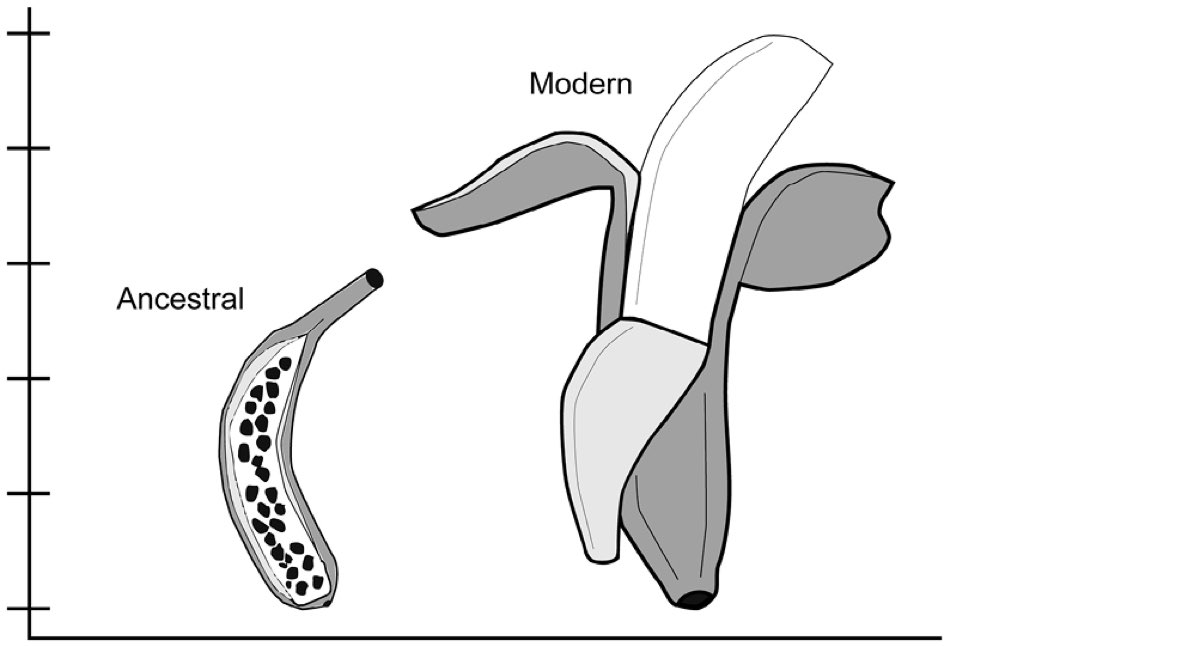
Figure 1. “Natural” banana versus the modern variety. An ancestral banana (left) juxtaposed with a modern banana (right) in relative scale. The modern banana was selectively bred over many generations to become larger and to have imperceptible, comestible seeds.
Instead, in the cases where naturalism seems to engender positive outcomes, we apply more precise principles rather than relying on the same to explain the benefits. For example, a paleo diet may indeed be healthier than a diet of just fast food. However, it’s not the naturalness of the paleo diet that necessarily confers nutritional superiority. Less free sugars or lower glycemic indices in a paleo diet will better explain the diet’s effectiveness than the perceived naturalism of the food itself. Similarly, barefoot running may indeed be better for us than running with sneakers because of how human biomechanics work: one study showed that barefoot runners experience less impact on their feet because of how a bare foot strikes the ground.10 We do not need to apply the naturalism principle to market these concepts in such instances because more precise explanations—better knowledge—are available.
Clinging to the naturalism fallacy results in terrible consequences. The anti-vaccine movement routinely appeals to naturalism to promulgate its message. The subtext is that vaccines are not natural and are thereby dangerous, despite their obvious and visible benefit to society over the years. Homophobic movements often denigrate homosexuality by claiming that same-sex couples are unnatural.11 Similarly, we’re constraining one of the most promising technologies currently available, genetic engineering, due to retrograde impulses against genetically modified organisms (GMOs). (Chapter 5 will greatly expand on and refute the anti-GMO sentiment.) Ultimately, invoking naturalism as an argument will slow the transition away from animal products because it’s so terribly imprecise when superior arguments exist. “Natural” is an empty, uninformative adjective used to market consumer goods, but often has little relevancy when examined in depth.
The Evolutionary Imperative
Some groups and individuals subscribe to “evolutionary naturalism,” arguing that evolutionary forces have shaped us into the beings we are today. These forces formed our minds, bodies, emotions, and values, for better or worse. In their opinions, our lives and actions should be about slaking these forces or, at the least, these forces should excuse certain behaviors. For example, eating animals is often seen as necessary for positive human evolutionary development. One theory suggests that human society evolved as a result of the effort required to hunt large animals and share the spoils.12 This history occurred for most of the 200 thousand years since Homo sapiens first speciated, i.e. split off from Homo erectus, to form an independent species. Therefore, according to some advocates of meat-eating, as an established core facet of our evolutionary heritage, carnivore-centric diets are necessary to ensure our continued progress as a species. Again, this is a terrible argument. By that logic, it would be evolutionarily better to remain segregated in small tribes similar to those we populated for most of human history and forego the organized, vast global societies we have built. But if we did that, we’d lose the interconnectedness to tackle the enormous problems facing all of society, such as mass vaccination and climate change. In other words, we cannot always look back to go forward. The Theory of Evolution alone cannot dictate the life that we are to lead. However, the science behind the Theory of Evolution can explain how biological life changes over time.
Specifically, the Theory of Evolution explains how a species changes given the variation between members of the species and the selection pressure applied to them. For all biological entities, at least one selection pressure is obvious: the imperative to reproduce. If a species does not easily or eagerly reproduce, then that species dies out. Consequently, we have been shaped by evolutionary forces to pursue and enjoy sex. Obviously, if we had not been programmed in this manner, then our kind would have quickly died out. Likewise, we must eat to survive. Therefore, evolutionary forces shaped us to feel weakness and pain when we need food and energized and happier once we’ve satisfied that hunger.
How does evolution shape a species? Charles Darwin, the progenitor of the Theory of Evolution, has a famous example. Darwin formed his ideas about evolution by observing ground finches in the Galapagos Islands. The finches feasted upon seeds, and their different beak sizes led to separate advantages and disadvantages when eating different types of seeds. A large beak allowed the finch to break through hardy seeds, while the smaller beaks could more speedily devour small seeds. If an island had more small seeds, small-beaked finches would eventually dominate the area, eating seeds faster than their large-beaked brethren. Conversely, if the island’s flora favored larger, hard seeds, the large-beaked birds would proliferate instead. The Theory of Evolution posits that, given variation among beak size in the finch species, a selection occurs. The birds whose beaks allow them to consume more food, more efficiently, will reproduce faster than the birds with smaller beaks. This variation is key. If there is no variation among beak size and all the birds had the exact same beak, then selection cannot occur, and the population will maintain an unchanging beak size across generations. The beak size variation, as we found out later, stems from variation in the DNA. Natural chemical mutations and biological inheritance change the DNA between finches, resulting in different beak lengths.
Suppose a consequential scenario: a volcanic eruption suddenly wipes away the small seeds, leaving only large, hard seeds. The change is permanent, and the seeds remain large and hard for years to come. Suppose that based on an average beak size of 1 centimeter, that beak sizes range from 0.8 to 1.2 centimeters before the eruption. Often such properties are visualized with a distribution (Figure 2) where most finch beak sizes occur at the mean, but a variation occurs around this value.
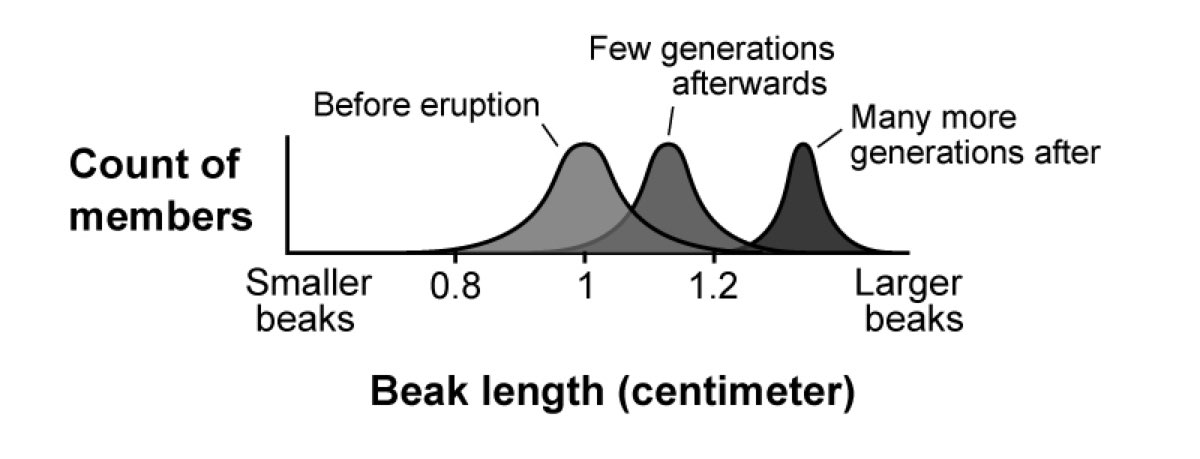
Figure 2. The shift of beak lengths after a volcano eruption. The leftmost curve highlights a distribution of beak lengths for the finch species. Most finches have a beak length of 1 centimeter, and few have 1.2 or 0.8 centimeters. After the volcanic eruption, the distribution of beak lengths shifts rightward (gets bigger) over the generations.
After the volcanic eruption, every finch is disadvantaged initially. All of them struggle to eat the remaining large seeds; however, not everyone struggles equally. The few with larger beaks at 1.2 centimeters sate their hunger slightly more easily and consequently are able to sire more progeny. In contrast, the 0.8-centimeter-beaked finches struggle more and are unable to sire offspring as quickly as even the average finch. As a result, in the next generation, the distribution of finch beak sizes shifts. This shift continues into the next generation and the generation after that until a new equilibrium is reached. Obviously, there can be a point where too long a beak is disadvantageous, imaginably when the beak is so heavy it hampers flying or the finch’s ability to move its head.
Another potential scenario is that the finches learn how to eat something other than seeds. Maybe they start eating cactus fruit. Initially, they’re ill-suited, but once again there is some sort of variation in their ability to eat such fruit, such as harder skin to shield against thorns or sharper talons to rip apart the fruit. This trait once again potentiates over the generations, and after a number of generations, a new cadre of finches thrives with sharp talons, tough skin, and a predilection for cactus fruit. This new finch population enters a different niche of their ecosystem. Before they were in the seed-eating niche, and now they occupy the cactus fruit–eating niche.
To clarify how the Theory of Evolution is often misunderstood: there is no magical evolutionary “force” that shapes all members of the species equally. After the volcanic eruption that leaves only large, hard seeds, evolutionary forces do not magically lengthen the beaks of all the finches. There is no Jedi or deity that magically conjures this consequence into existence. The distribution of the beak sizes for the finches shifts across generations and the beak gets longer because the long-bill finches survive and reproduce more effectively than the short-bill ones, thereby passing on their DNA.
Because we understand the mechanism of The Theory of Evolution so well, we can apply it to finding new technology for future generations. In directed evolution, scientists find new proteins with desired functionality. I can apply a selection pressure to a pool of varied proteins to enrich the opportunity for proteins with a specific behavior, such as the ability to form fibers that texturize vegan steaks of the future. Over time, just as with the finch population, the protein population is enriched with proteins that survive the selection pressure—a measurement of some sort, perhaps, of how well proteins bind together into fibers or those fibers having the correct amount of strength. The selected proteins perform a function not found without that pressure in the natural world. In fact, I used such a directed-evolution strategy in the aforementioned alternative casein proposal.
So, it would seem that we have a lot to thank evolutionary forces for; without them, we would not be who we are today, both individually and societally. However, this does not mean we should regard our evolutionary imperatives with unquestionable reverence. In fact, we already refute some evolutionary imperatives for our ancestral niche. Consider reproduction, mentioned briefly above. Reproduction has been an evolutionary selection pressure for virtually all life at some point in time. However, this is not true if you live in any developed society today, especially if you’re a fertile woman. Very few women in developed societies with access to family planning seek to be continuously pregnant or to mother as many kids as humanly possible. The opposite is likely truer, as constantly birthing and raising children takes a tremendous physical and economic toll on the health and wellbeing of a mother, and thereby her birthed children. This fact is affirmed in empirical data as well. As societies develop, people earn higher incomes and have access to water, food, education, birth control, and economic opportunities, the growth rate of the populations slows. Now, developed countries such as Denmark and Japan have a negative growth rate, meaning that the average woman is bearing fewer than 2.1 children.13 This means that the population of these countries is diminishing. It requires, on average, 2.1 children per woman to replace the population. Even in emerging countries such as Bangladesh, the average woman now has 2.1 kids, down from a prolific 6.95 in 1970.14
The second selection pressure—starvation and food security—is being solved as well. Never before in human history have we had such access to abundant, rich foods. As Yuval Noah Harari highlights in Sapiens,15 we’re more likely to die from problems related to overeating (e.g. heart disease) than from starvation itself. In fact, to Harari’s point, twenty-five percent of deaths in the United States stem from heart disease.16 I concede that starvation is not a problem we’ve completely eliminated; there are still places, namely in Africa, where widespread famine persists. However, we have reason to be hopeful, as the trends point to an overall increase in food security and a corresponding decrease in widespread starvation.
We are solving (e.g. decreasing starvation, overcoming natural predators, surviving disease and infections) or rejecting (e.g. uncontrolled reproduction, tribal mentality) the selection pressures long imposed on our species by the Theory of Evolution. The Theory of Evolution cannot tell us what to do or not to do. Where do we go from here? Humanity has rationalized other problems to solve, and among those problems, it is my contention that overreliance on animal products merits our attention.
Solving Other Problems
After solving our own problems of starvation and predators, we are attempting to tackle other problems unrelated to natural evolution; for instance, extreme poverty. Jeffrey Sachs in The End of Poverty extols our pursuit and highlights the heartening progress in the reduction of poverty.17 The book was published fifteen years ago, so I’ll showcase the more recent, impressive numbers: According to the World Bank, the percentage of people living in extreme poverty has declined from 42.1% of the world population in 1980 to about 10% in 2015.18 For China alone, 850 million people have risen out of extreme poverty in the same time span.19 I fully concede that we have not solved all of poverty, for there is still around ten percent of people globally who suffer, but the overall trend is hopeful.
Our efforts to allay poverty and suffering have largely been intentional. Humanity purposefully eliminated smallpox using a combination of vaccination and coordinated medical efforts led by organizations such as the Pan American Health Organization, the World Health Assembly, and the World Health Organization. At the onset of those activities in 1959, smallpox killed more than 2 million people per year.20 Approximately twenty years later, the disease was declared eradicated by the World Health Organization. The last known case was in 1975.21 By eliminating smallpox, we’ve improved one of the many determinants for lifting others out of poverty, thereby promoting knowledge-transfer across generations. When folks are wiped out by disease, their knowledge is lost to subsequent generations. For example: an experienced farmer struck down by disease before she is able to convey her savoir-faire completely to her children. Her lost knowledge is tantamount to lost wealth and will only exacerbate her children’s losses and/or poverty. Eliminating disease has not been the only accomplishment from organized global efforts to help eliminate suffering. With pest-resistant crops, cleanliness education, access to clean water, healthcare, and availability of mosquito nets, extreme poverty and its associated ills continue to wane.
However, we should not be satisfied only with helping people in extreme poverty. Sachs defined extreme poverty as the state where individuals did not know if they’d survive until the next day, such as not knowing their next food source. The next rung up the human development ladder is still poverty, just not as extreme. In this rung, food and water security spans a few days. Ideally, we’d continue to raise the standard of living for people on this rung so that they never worry about dying of hunger or thirst. In addition to tackling poverty, we are still working to raise other standards, such as clean, safe, and secure living spaces as well as basic access to health care and education. Nonetheless, we should feel emboldened by the progress of humanity. These problems are tractable, and directed and vetted efforts have paid dividends.
The subtext to The End of Poverty is that problems always must be solved in steps, starting with the most pressing need, which is generally water or food insecurity. Sometimes this requires a solution with obvious problems of its own. A business may set up a textile factory where workers spend long hours, pejoratively called sweatshops. Sweatshops are often derided for imposing terrible working and living conditions on workers. However, when critiquing sweatshops, we must always ask what the alternative might be. If the loss of the sweatshop means the people remain destitute and starving to death, then that suggests that the sweatshop, as bad as it is, solves a more direct and lethal problem, and is therefore part of net progress. The goal, of course, is to eventually elevate working conditions for all people. The next rung of the ladder.
In another example of this step-by-step view, consider the needs of an impoverished farmer in Brazil. Even though people in wealthier countries would prefer it, this farmer cannot prioritize rainforest preservation if he is struggling to feed his family or pay for medicine. His survival may be better served by burning the rainforest down to open more fallow land so he can grow more crops to feed his family. In this case, improving and securing his living standards would also help solve the environmental problem of deforestation. Given this kind of security, the farmer would likely not prefer the forest to be aflame, but without it, his hand is forced by the circumstances. Philosopher Will MacAskill estimates that a donation of a mere $105 to the organization Cool Earth,22 which directly supports the education and income development of locals who inhabit rainforest areas, would offset the carbon dioxide produced in one year by an American adult.23 Making the lives of rainforest inhabitants better ultimately solves the downstream environmental problem of deforesting the region.
Therefore, as we choose problems to tackle, we should be selective: we want to tackle the most pressing, tractable problems first in order to have the largest impact. I’m certainly not the first to raise this notion; in fact, the Effective Altruism movement has adopted and spread this philosophy since the late 2000s. We cannot market environmentalism and sustainability to destitute farmers in Brazil. We cannot instantly expect United States-level workplace standards for an area experiencing widespread, extreme poverty. We should, however, choose important, impactful problems to tackle. The inefficiency of animal agriculture is one of those problems.
How to supplant animal agriculture is not just an environmental or a moral problem, it’s also an economic and technological problem. Replacing or superseding animal agriculture with non-animal resources can help alleviate extreme poverty as well as other “luxury” problems such as environmental issues. As we know, water and food insecurity are hallmarks of extreme poverty. Reducing water usage elsewhere would assuage such insecurities. Animal agriculture requires a tremendous amount of water, especially in proportion to the food it renders. A technology that provides the same food using less water would help curtail water inequities and extreme poverty.
I predict and assert that animals will be replaced, especially as protein products in the human diet. While I’m confident in this prediction, I cannot state how—exact futurology is impossible, argued in Appendix A. The fundamental physics of our universe simply makes such prognostication impossible in many areas, especially in regard to technological development. But we can proclaim how terrible certain technology is, especially when replacements are just visible over the horizon. In the next chapter, we’ll discuss a future free of animal agriculture and the features of the technology that will make it possible.
Chapter Terms
- heterologous expression: porting a DNA sequence from one organism to another
- gene: the minimal, contiguous DNA sequence needed to encode a protein
- naturalism: the fallacious, imprecise idea that there is something inherently good about what’s “natural”
- variation: the spread of a specific trait, or the width of the distribution. For example, if human height was equally distributed between four feet and seven feet, then that would be more variation than if all humans were 5.5 feet tall
- selection pressure: any environmental feature that causes more reproductive success for a portion of a species based on trait variation
- evolution: an explanation for how a species changes given a selection pressure and variation within a species
- niche: the role occupied by a species, including what the species typically eats
- directed evolution: intentionally using the Theory of Evolution to impose a selection on a population (often a pool of proteins) to enrich for a subpopulation with a specific trait
Chapter Summary
Since the modern Enlightenment (around the 17th century), increased knowledge and scientific discovery has enabled humanity to begin to solve the most exigent of our societal problems that threaten the natural evolution of our species, namely mass starvation, disease, and poverty. Fewer people today die or suffer from starvation, disease, or lack of water than ever before. We’ve also largely moved away from our evolutionary imperatives. Generally speaking, we do not seek to reproduce as much as possible and, in developed and emerging countries, are not satisfied with mere survival. We also eschew what’s “natural,” which has no precise meaning to us anymore despite the ubiquitous marketing.
At this point in time, innovators and global thinkers are following new pursuits, lifting the remaining 10% of the population that exists in extreme poverty to livable conditions, reducing hunger and disease in affected populations, and educating and training people for the work of the future. Problems must be tackled strategically and in stages. For example, trying to teach someone to read is fruitless if they are hungry and ill. Therefore, the most egregious problems must be addressed first. The world’s reliance on animal agriculture is one of these fundamental problems, and we’ve already started endeavors to eliminate it. Supplanting animal agriculture with more sustainable plant-based protein creation portends cascading effects that will solve all sorts of problems ranging from water scarcity to all kinds of other environmental issues.
Footnotes
-
Humira Price. True Med Cost. https://www.truemedcost.com/humira-price/ (Accessed December 14, 2019). ↩
-
Adalimumab - Drug Usage Statistics, ClinCalc DrugStats Database. ClinCalc.com. https://clincalc.com/DrugStats/Drugs/Adalimumab (Accessed November 1, 2020).
DailyMed - IMRALDI- Adalimumab Injection, Solution. U.S. National Library of Medicine. https://dailymed.nlm.nih.gov/dailymed/drugInfo.cfm?setid=acdfaa71-27ed-4717-8e7d-f1a5fe0d1fa6 (Accessed November 1, 2020). ↩
-
Quianzon, C. C., & Cheikh, I. (2012). History of insulin. Journal of Community Hospital Internal Medicine Perspectives, 2(2), 18701. https://doi.org/10.3402/jchimp.v2i2.18701. ↩
-
Holland, J. W. (2008). Chapter 4—Post-translational modifications of caseins. In A. Thompson, M. Boland, & H. Singh (Eds.), Milk Proteins (pp. 107–132). Academic Press. https://doi.org/10.1016/B978-0-12-374039-7.00004-0. ↩
-
McEvoy, M. (2019). Organic 101: What the USDA Organic Label Means. U.S. Department of Agriculture. https://www.usda.gov/media/blog/2012/03/22/organic-101-what-usda-organic-label-means (Accessed November 3, 2020). ↩
-
Healthy Lives | Natural Diet - How to Eat More Naturally. Healthy Lives. https://www.healthylives.com/kb/natural-diet/ (Accessed January 18, 2021). ↩
-
Rogers, O. (2019). The 4 Ns Of Meat-Eating. Faunalytics. https://faunalytics.org/the-4-ns-of-meat-eating/ (Accessed November 3, 2020). ↩
-
USDA Organic. U.S. Department of Agriculture. https://www.usda.gov/topics/organic (Accessed January 18, 2021). ↩
-
Mayo Clinic Staff. (2019). Paleo diet: What is it and why is it so popular? Mayo Clinic. https://www.mayoclinic.org/healthy-lifestyle/nutrition-and-healthy-eating/in-depth/paleo-diet/art-20111182 (Accessed December 26, 2019). ↩
-
Lieberman, D. E., Venkadesan, M., Werbel, W. A., Daoud, A. I., Dandrea, S., Davis, I. S., Mangeni, R. O., & Pitsiladis, Y. (2010). Foot strike patterns and collision forces in habitually barefoot versus shod runners. Nature, 463(7280), 531–535. https://doi.org/10.1038/nature08723. ↩
-
Kirk Cameron Tells Piers Morgan Homosexuality Is ‘Unnatural,’ ‘Ultimately Destructive.’ (2016). HuffPost. https://www.huffpost.com/entry/kirk-cameron-piers-morgan-homosexuality-unnatural_n_1318430 (Accessed December 26, 2019). ↩
-
Tomasello, M., Melis, A. P., Tennie, C., Wyman, E., & Herrmann, E. (2012). Two key steps in the evolution of human cooperation: The interdependence Hypothesis. Current Anthropology, 53(6), 673–692. https://doi.org/10.1086/668207. ↩
-
Fertility Rate, Total (Births per Woman) | Data. The World Bank. https://data.worldbank.org/indicator/SP.DYN.TFRT.IN (Accessed December 26, 2019). ↩
-
Fertility Rate, Total (Births per Woman) - Bangladesh. The World Bank. https://data.worldbank.org/indicator/SP.DYN.TFRT.IN?locations=BD (Accessed December 26, 2019). ↩
-
Harari, Y. N. (2018). Sapiens: A Brief History of Humankind. Reprint edition. New York: Harper Perennial. ↩
-
CDC. (2019). Heart Disease Facts. Centers for Disease Control and Prevention. https://www.cdc.gov/heartdisease/facts.htm (Accessed December 26, 2019). ↩
-
Sachs, J. (2006). The End of Poverty. Economic Possibilities for Our Time. Reprint edition. New York, NY: Penguin Books. ↩
-
This metric is normalized (adjusted) for inflation and purchasing power. Specifically, it’s defined as $1.90 a day (2011 PPP). Poverty Headcount Ratio at $1.90 a Day (2011 PPP) (% of Population) - World | Data. The World Bank. https://data.worldbank.org/indicator/SI.POV.DDAY?locations=1W&start=1981&end=2015&view=chart (Accessed December 26, 2019). ↩
-
Poverty Headcount Ratio at $1.90 a Day (2011 PPP) (% of Population) - China| Data. The World Bank. https://data.worldbank.org/indicator/SI.POV.DDAY?locations=CN (Accessed December 26, 2019). ↩
-
Elwood, J. M. (1989). Smallpox and its eradication. Journal of Epidemiology & Community Health, 43(1), 92–92. https://doi.org/10.1136/jech.43.1.92. ↩
-
WHO | Smallpox. (2007). WHO Media centre. https://web.archive.org/web/20070921235036/http://www.who.int/mediacentre/factsheets/smallpox/en/ (Accessed December 26, 2019). ↩
-
Cool Earth | Working to Support Rainforest Communities to Reduce Deforestation. https://www.coolearth.org/ (Accessed December 15, 2019). ↩
-
MacAskill, W. (2016). Doing Good Better: How Effective Altruism Can Help You Help Others, Do Work That Matters, and Make Smarter Choices about Giving Back. Reprint edition. Avery. ↩
Text licensed CC BY 4.0; figures excluded — see the license.